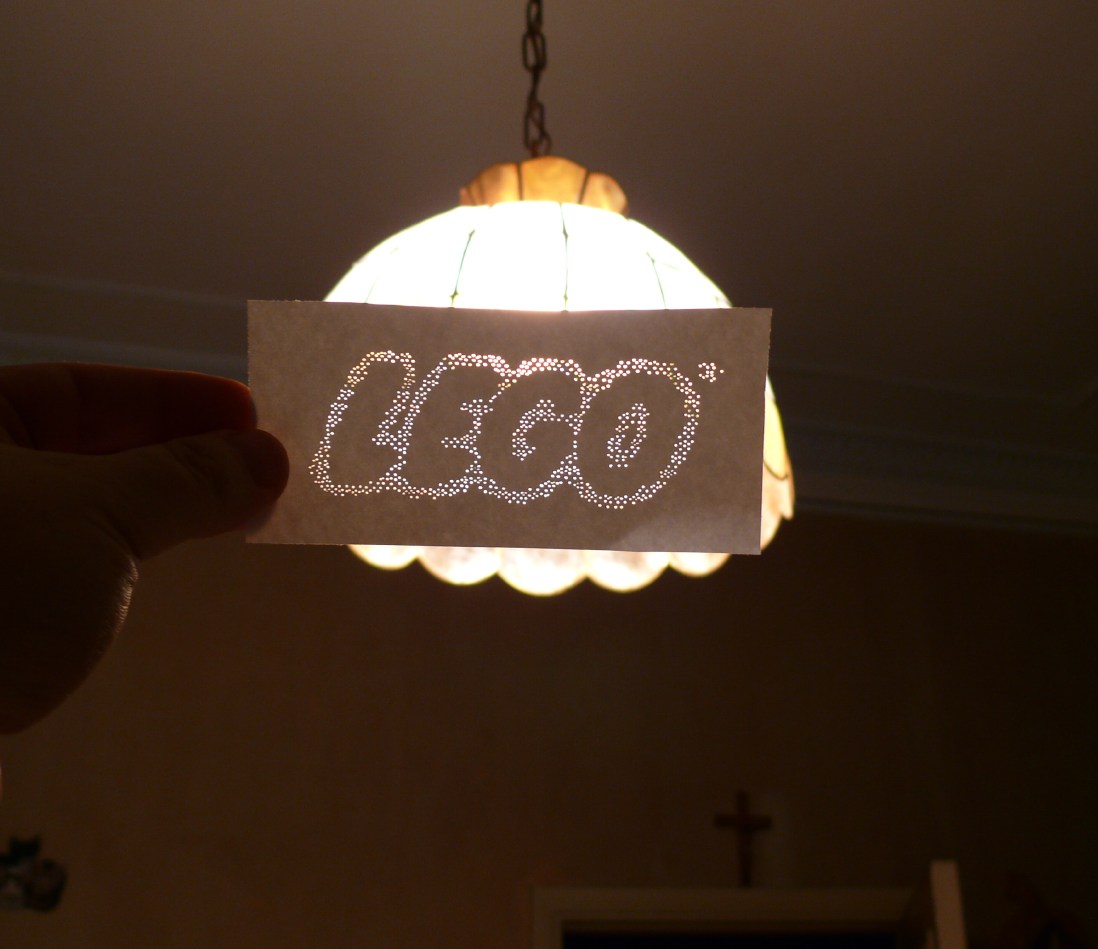
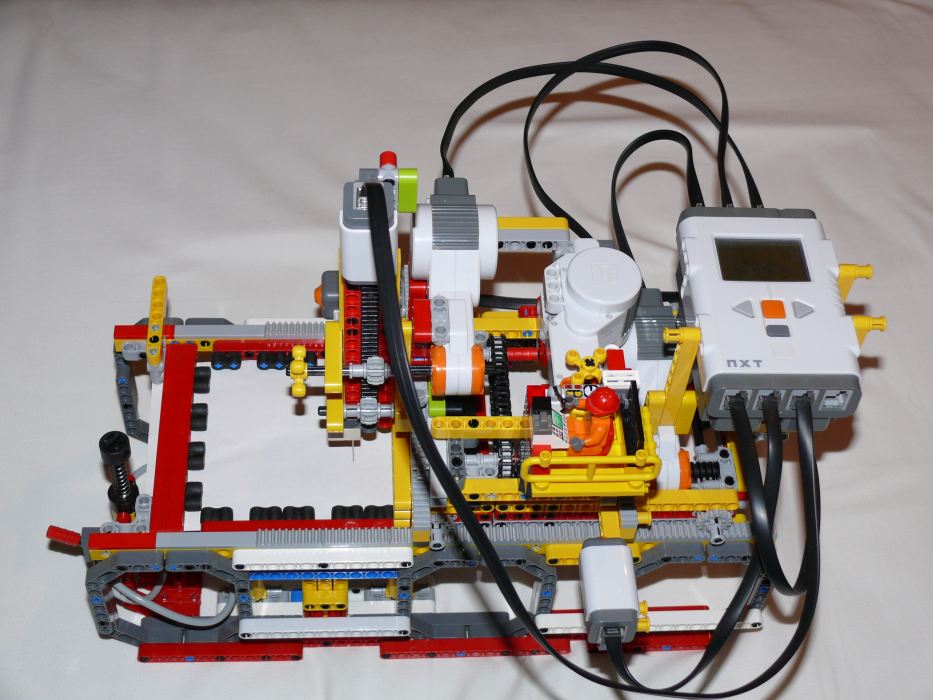
NXT Pin plotter

Check out this amazing plotter that pokes tiny pin holes in paper. The creator says that can 'print' 1.3 pin holes every 1 mm.
Other Specifications:
  • printable area: 91×70mm (3.6"x2.7")
  • maximum resolution: 1.3 holes/mm (33 dpi), using a 0.3mm needle
  • time to print a bitmap of about 1,500 holes: some 35-40 minutes
  • materials: only LEGO parts (one NXT brick, three NXT motors, three NXT touch-sensors, lots of Technic bricks) except the needle
  • software: 14k of NXC commented source
  • "printable" media: 105mm-wide paper sheets (best results using 80-100g/mq paper), plastic sheets (not too thick), kitchen "aluminium sheets"...
  • NXT brick batteries: 6× 1.2V NiMH AA batteries (rated "2300mAh") allow 100 to 150 minutes printing


Full details at his website: http://www.alfonsomartone.itb.it/naxntb.html

--
Damien Kee
Popular posts from this blog

Celebrating 25 Years of MINDSTORMS

In celebration of the 25th Anniversary of MINDSTORMS, we take a trip through history. Please also visit ROBOTMAK3RS Community every week as we highlight different projects all through 2023 in celebration of the anniversary. Some of the early history is based on the content shared by  Coder Shah  in our  MINDSTORMS EV3 Community Group . Some of the text and links may have been edited from his original posts for consistency and clarity.  1984 - Kjeld Kirk Kristiansen watched a TV program called "Talking Turtle," where MIT professor Seymour Papert demonstrated how children could control robot "turtles" using LOGO, a programming language he developed. 1988 - The collaboration between MIT and LEGO resulted in LEGO TC Logo in 1988, which allowed students to control LEGO models using computer commands. The video shows Papert demonstrating TC Logo. 1990 - LEGO TC Logo was hampered since the robots you built had to be tethered to a personal computer. LEGO and MIT...

ROBOTMAK3RS Review: LEGO River Steamboat

I thought the LEGO River Steamboat would be an interesting set for a ROBOTMAK3R review for a few reasons. First, the LEGO designer of the model is Marina Stampoli, a long-time collaborator of the late ROBOTMAK3R Vassilis Chryssanthakopoulo s. From earlier collaborations with Vassilis, I  knew Marina was incredibly talented, with an eye for aesthetics and functionality. Her background in architecture is particularly useful for her relatively new position at LEGO. Her other sets include the Magic of Disney (21352), Message Board (41839), and Red London Telephone Box (21347). Second, watching Marina's reveal video  and reading her designer interview made this set even more tempting to build. The gearing mechanisms running through the model gave way to many opportunities for automation using LEGO robotics elements. Since ROBOTMAK3RS is all about adding interactivity and automation to LEGO brick, I thought it would be fun to see where and how LEGO robotics could be added to this s...

Ghostbusters R.T.V Remix

Nino Guba is from Torrance, California, USA. He played with LEGO as a kid, but growing up in the Philippines, it wasn’t something he had easy access to. He only got reintroduced to LEGO when he moved to the US and had kids of his own. When his sons were younger, they received LEGO sets as gifts, but as they grew older, the sets got put into storage as their interest faded. Fast forward a few years, he started coming up with his own product ideas and thought about how he could quickly prototype them. That’s when he discovered LEGO MINDSTORMS—and was hooked! He raided his kids’ old collection, got everything organized, and now he's designing and building his own creations, blending his coding skills with LEGO robotics to bring ideas to life. Tell us about your Ghostbusters Remote Trap Vehicle (R.T.V) project. This project is a LEGO Technic adaptation of the Ghostbusters R.T.V.—a ghost trap converted into a remote-controlled vehicle. Its companion build is a prop replica of the Futaba...